
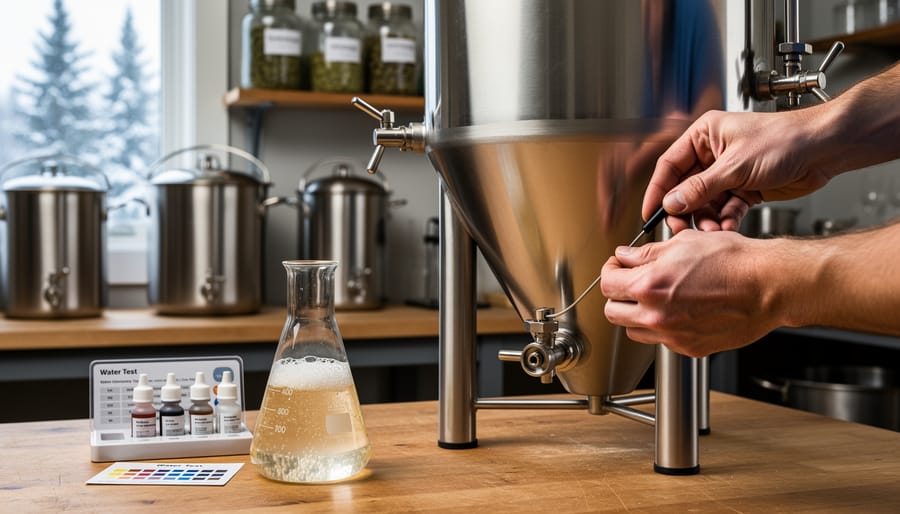
The Canadian homebrewing landscape is evolving faster than ever, and the brewers pushing boundaries today are sharing insights that can transform your next batch from ordinary to exceptional. Expert brewers across the country are currently reporting remarkable results by focusing on water chemistry adjustments specific to regional mineral profiles, with many seeing dramatic improvements in clarity and flavor balance within weeks of implementation. Temperature control during fermentation has emerged as the single most impactful variable according to recent interviews, with experienced brewers emphasizing that maintaining precise ranges between 18-20°C for ales yields consistently cleaner profiles than expensive ingredient upgrades.
The conversation has shifted from simply following recipes to understanding why certain techniques work in your specific brewing environment. Veterans are openly discussing their failures alongside successes, revealing that troubleshooting fermentation issues often comes down to pitching adequate yeast cells—a step many intermediate brewers still underestimate. What’s particularly exciting right now is how accessible expert knowledge has become through direct interviews and community exchanges, breaking down the barriers between weekend hobbyists and professional-level craft.
This wave of shared expertise means you’re no longer learning in isolation. Canadian brewers are building on each other’s discoveries, from Vancouver Island’s hop experimentation to Ontario’s creative use of local ingredients, creating a knowledge base that’s both regionally relevant and immediately applicable to your homebrew setup.
The Foundation: What Experts Say About Starting Right
Equipment That Actually Matters (According to the Pros)
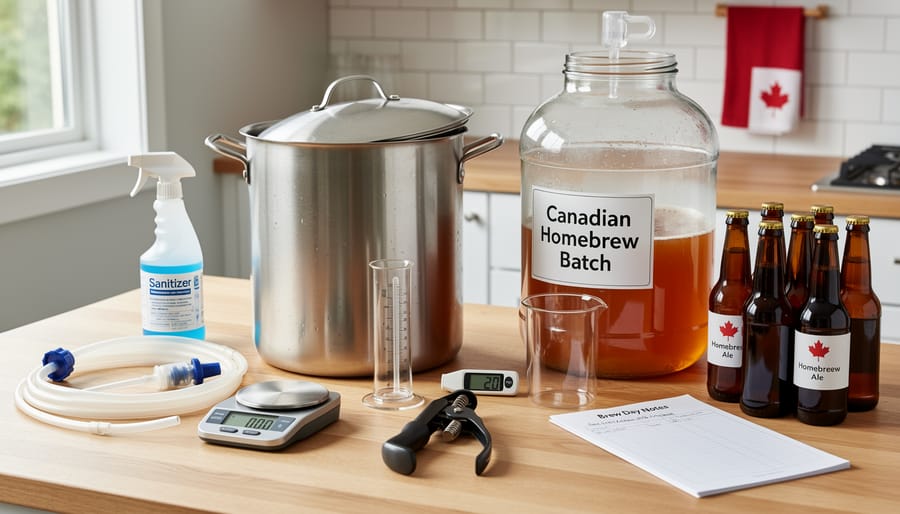
After interviewing dozens of award-winning Canadian homebrewers, a surprising pattern emerged: the best beer doesn’t come from the fanciest equipment. Most pros actually advocate for starting lean and upgrading only what genuinely impacts your brewing.
“I see new brewers drop two grand on gear they’ll never use,” says Marcus Chen, a Toronto-based brewer with three provincial medals to his name. “Meanwhile, I’m making competition-quality beer with equipment that cost me less than $400.” His perspective echoes throughout the Canadian brewing community, where practical wisdom trumps shiny gadgets.
The consensus among experts boils down to a core list of essentials that actually move the needle on beer quality:
- A quality fermenter with proper temperature control capability (even a simple swamp cooler works)
- Reliable thermometer and hydrometer for accurate readings
- Star San or similar no-rinse sanitizer (never skimp on sanitation)
- Large enough brew kettle for full-volume boils
- Proper storage for ingredients, especially temperature-stable space for hops
What’s notably absent? Expensive conical fermenters, elaborate cooling systems, and automated monitoring gadgets. “Those come later, if ever,” explains Sarah Bergeron from Montreal’s vibrant homebrew scene. “Temperature control and sanitation matter infinitely more than stainless steel bling.”
The minimalist approach these brewers champion isn’t about being cheap. It’s about understanding that consistent processes and fresh ingredients deliver better results than premium equipment paired with sloppy technique. Several pros mentioned they still use their original plastic bucket fermenters alongside newer gear, proving that upgrading should be intentional, not aspirational.
The takeaway? Master the fundamentals with basic equipment before considering upgrades. Your taste buds won’t know the difference, but your wallet certainly will.
The Ingredient Quality Question
Here’s where seasoned brewers tend to agree: your base malt and hops deserve the lion’s share of your ingredient budget. “Fresh hops are non-negotiable,” explains Nova Scotia brewer Jamie Chen, who’s been crafting award-winning IPAs for over a decade. “That’s where your aroma and flavour complexity lives. Buy from reputable suppliers who date their packages and store them properly.”
The good news for Canadian brewers? You can absolutely economize on certain ingredients without noticing a difference in your glass. Many experts suggest that table sugar works perfectly fine for priming bottles, and generic Irish moss performs just as well as premium brands for clarity. The key is understanding which elements actually impact flavour versus those that serve purely functional roles.
When it comes to evaluating brewing ingredients, freshness often trumps brand names. Ontario brewer Marcus Singh recommends building relationships with local homebrew shops that understand proper storage. “In Canada’s climate, temperature fluctuations during shipping can affect quality more than the brand itself,” he notes.
The sourcing challenge unique to Canadian brewers often comes down to availability rather than quality. While specialty malts from Europe might seem premium, several experts pointed to excellent Canadian maltsters producing comparable products at better prices with shorter shipping times. Consider supporting domestic producers for base malts while splurging on imported specialty grains that truly make a difference in your specific beer style.
Temperature Control: The Make-or-Break Factor
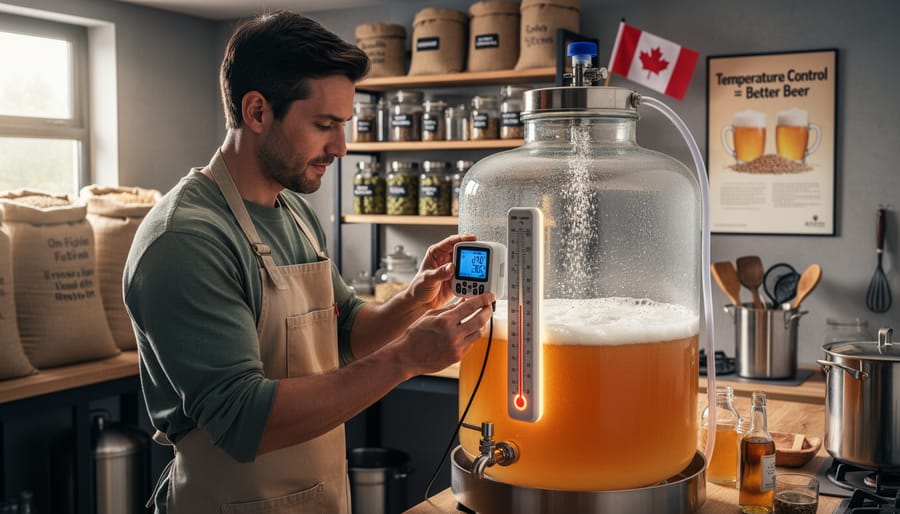
Ask any experienced brewer what separates excellent beer from mediocre batches, and the answer comes back unanimous: temperature control. While beginners often obsess over recipes and ingredient quality, the experts we spoke with repeatedly emphasized that maintaining proper fermentation temperature control determines whether your carefully selected malts and hops will shine or disappoint.
“I’ve seen gorgeous ingredient lists produce terrible beer because someone fermented an ale at 24°C in their furnace room,” explains Marcus Chen, a master brewer from Edmonton with fifteen years of experience. “Temperature affects everything: ester production, fusel alcohol formation, yeast health, and ultimately, the flavour profile of your finished beer.”
For Canadian homebrewers, seasonal temperature swings present unique challenges. Winter basement temperatures can plummet to 12°C, while summer heat pushes the same space past 24°C. This rollercoaster makes consistent brewing nearly impossible without intervention.
The good news? You don’t need expensive equipment to solve this. Montreal-based brewer Sarah Levesque shared her practical approach: “I use a simple temperature controller paired with a mini-fridge I found on Kijiji for fifty bucks. It maintains perfect fermentation temperatures year-round, and it’s the single best investment I’ve made in my brewing setup.”
For those without space for a dedicated fridge, water bath setups work surprisingly well. Vancouver homebrewer TomRidge swears by his cooler-based system: “I place my fermenter in a large cooler with water, then add frozen water bottles or a small aquarium heater depending on the season. It’s low-tech but incredibly effective.”
The experts agree that investing in even basic temperature monitoring pays immediate dividends. Digital stick-on thermometers cost just a few dollars and provide invaluable feedback. “Once you start tracking fermentation temperatures consistently, you’ll immediately understand why some batches turned out better than others,” Chen notes. “It’s the fastest way to level up your brewing game.”
Recipe Development Wisdom from the Field
The Clone vs. Create Debate
Here’s a question that sparks lively debate in brewing circles across Canada: should you start by cloning commercial beers or jump straight into original recipes? According to experienced brewers we’ve spoken with, the answer might surprise you.
“Cloning is like learning to paint by copying the masters,” explains Toronto-based brewer Sarah Chen, who’s been teaching homebrewing workshops for over a decade. “You’re reverse-engineering success, which teaches you why certain ingredients work together.” When you attempt to recreate your favourite craft lager or IPA, you’re forced to think critically about malt profiles, hop schedules, and fermentation temperatures in ways that recipe books don’t always capture.
The real magic happens when cloning goes slightly wrong. Montreal brewer Jacques Fontaine shares that his best original recipe came from a failed Belgian dubbel clone. “I learned more from that mistake than from ten perfect batches. You start understanding how ingredients interact, not just following instructions.”
However, some experts advocate for creative exploration from day one. “Original recipes build confidence and intuition faster,” argues Vancouver’s craft brewing educator Mike Thompson. “You learn to trust your palate and make decisions, not just execute someone else’s vision.”
The consensus? Try both approaches. Clone beers you love to build technical knowledge, then apply those lessons to original creations. This balanced method develops what brewers call “recipe intuition” – that sixth sense for knowing what will work before you even heat the water.
When to Trust Your Taste
Every brewer reaches that pivotal moment when they realize their palate is their most valuable tool. For Toronto-based brewer Sarah Chen, it happened during her thirtieth batch of pale ale. “I kept following recipes to the letter, wondering why my beer tasted flat compared to commercial versions,” she recalls. “Then I added an extra half-ounce of Citra hops purely on instinct. That’s when everything clicked.”
The key to trusting your taste lies in building a sensory library. Vancouver’s Michael Tremblay, who’s been brewing for fifteen years, suggests keeping a tasting journal. “Write down everything you notice, even if it sounds silly. Is there a hint of grapefruit? Does it remind you of wet cardboard? These observations train your palate to identify both flaws and triumphs.”
Breaking the rules becomes easier once you understand why they exist. Montreal brewer Jamie MacDonald learned this after accidentally mashing at 158°F instead of the recipe’s recommended 152°F. “The beer turned out richer and fuller-bodied. Now I adjust mash temperatures intentionally based on the mouthfeel I’m chasing.”
The Canadian brewing community thrives on experimentation, from prairie wheat additions to Maritime spruce tips. Your breakthrough moment might come from embracing local ingredients or simply trusting that the aroma in your fermenter smells exactly right, even if it differs from expectations. Remember, recipe guidelines are starting points, but your developing palate is the finish line.
Troubleshooting Like a Pro: Expert Problem-Solving Approaches
When something goes sideways in your brew, the difference between a novice and an experienced brewer isn’t just knowledge—it’s mindset. Veteran Canadian homebrewers have learned that successful troubleshooting starts with staying calm and thinking systematically rather than immediately dumping the batch or frantically adjusting multiple variables at once.
“The biggest shift I see in brewers who level up is patience,” says Toronto-based homebrewer Marcus Chen, who’s been brewing for fifteen years. “Beginners panic and start changing everything. Experienced brewers step back, observe, and follow a logical process.”
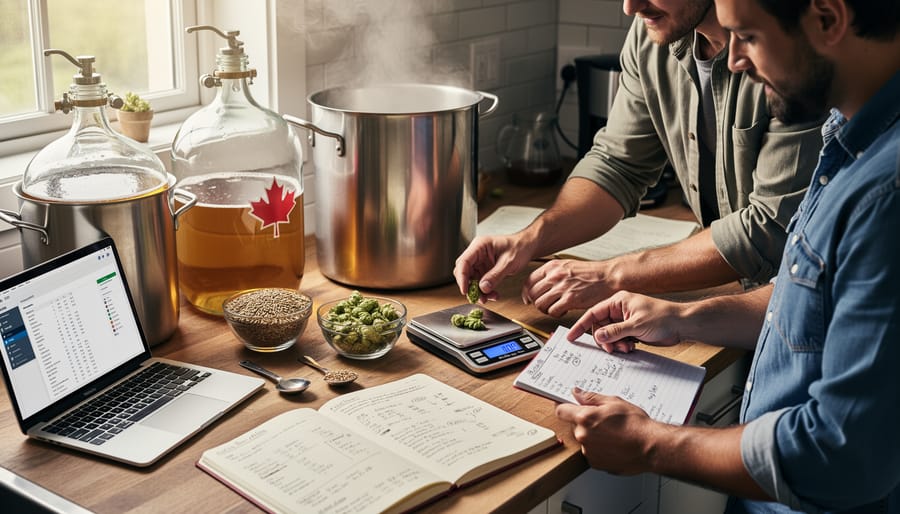
That process starts with documentation. Expert brewers consistently emphasize keeping detailed notes during every brew session—temperatures, times, gravity readings, even the weather that day. When issues arise, these notes become your diagnostic roadmap. Without them, you’re just guessing.
| Problem | Beginner Assumes | Expert Checks First |
|---|---|---|
| Off-flavours | Bad yeast or ingredients | Fermentation temperature consistency |
| Low carbonation | Need more priming sugar | Bottling temperature and mixing method |
| Stuck fermentation | Dead yeast | Pitch rate and oxygenation levels |
| Cloudy beer | Infection present | Cold crash duration and fining agents |
The expert approach also involves isolating variables. If your beer tastes different than expected, experienced brewers change only one thing at a time in subsequent batches. This methodical testing reveals actual causes rather than creating new mysteries.
Vancouver brewer Sarah Kowalski, who teaches brewing workshops across British Columbia, recommends the “wait and see” approach before intervening. “Give your beer time,” she advises. “What looks like a problem on day three might resolve itself by day seven. I’ve seen countless beginners throw out perfectly good beer because they jumped to conclusions too quickly.”
Community engagement plays a crucial role too. Experienced brewers actively participate in local brewing clubs and online Canadian homebrewing forums, where they can describe issues and get multiple perspectives. This collaborative troubleshooting often reveals solutions that individual research might miss.
The mindset shift ultimately comes down to viewing problems as learning opportunities rather than failures. Every batch that doesn’t go perfectly teaches something valuable, building the intuition that separates adequate brewers from exceptional ones.
Building Your Brewing Knowledge: Resources Experts Actually Use
The most dedicated homebrewers I’ve spoken with share a common trait: they never stop learning. But here’s the thing—they’re selective about where they get their information.
“I used to consume every brewing video and blog post I could find,” admits Marc Levesque, a Toronto-based brewer with twelve years under his belt. “Now I stick to peer-reviewed sources and communities where people actually test what they’re talking about.” He points to sites like Brulosophy for their experiment-driven approach and the Canadian Homebrew Competition forums for real-world feedback from fellow Canadian brewers.
Online communities remain vital, but not all are created equal. The Ontario Brewing Community on Facebook and r/CanaHomeBrewers on Reddit consistently get mentioned as places where information is vetted and beginners aren’t dismissed. “You can ask about water chemistry or wild yeast experiments and get thoughtful responses from people who’ve been there,” says Vancouver brewer Jennifer Wu.
For structured learning, many experts recommend courses from Brew Your Own magazine or the online programs through Niagara College’s Brewmaster and Brewery Operations. The college offers continuing education modules that homebrewers can access without enrolling in the full program—particularly useful for diving deep into specific topics like fermentation science or quality control.
Books still matter too. “How to Brew” by John Palmer gets cited constantly as a foundation text, while “For the Love of Hops” and the Brewing Elements series offer expert-level deep dives. Canadian-specific resources like the content from Great Canadian Beer Festival educators help brewers understand regional ingredients and water profiles.
Podcasts like Brew Files and The Brewing Network keep brewers current during commutes, while local homebrew clubs—found through provincial associations—provide hands-on learning that no online resource can match. The consensus? Blend multiple sources, prioritize proven science over trends, and stay connected with your local brewing community.
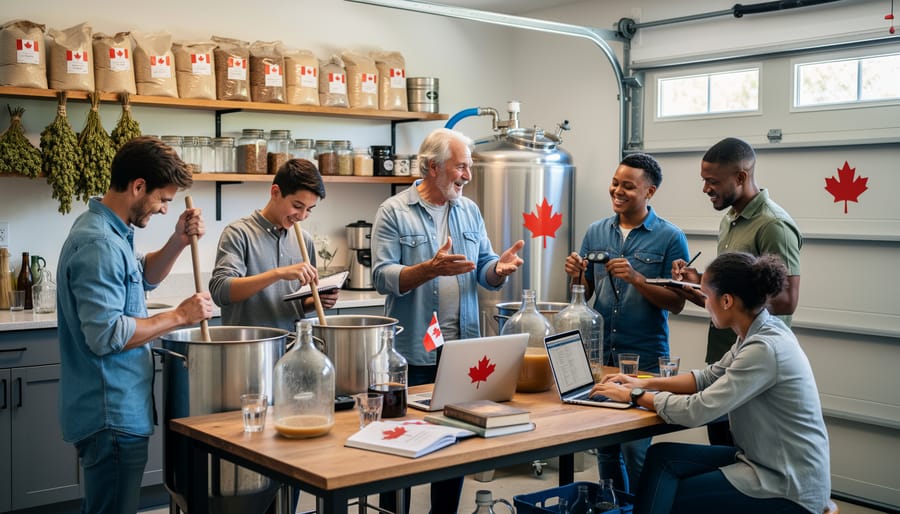
The Community Factor: Why Connection Matters
Ask any accomplished homebrewer about their journey, and they’ll almost certainly credit their local brewing community for accelerating their skills. “I learned more in my first six months attending a brew club than I did in two years brewing alone in my basement,” says Michael Chen, a Calgary-based brewer who now regularly medals in provincial competitions. “Someone would taste my beer and immediately identify issues I couldn’t detect myself. That feedback loop was invaluable.”
The brewing community across Canada offers multiple entry points for connection. Brew clubs exist in nearly every major city, from the Toronto Homebrewers Guild to Vancouver’s CAMRA chapter, providing monthly meetings where brewers share samples, discuss techniques, and troubleshoot problems together. Many clubs organize group buys of ingredients and equipment, making the hobby more affordable while building camaraderie.
Competitions represent another powerful learning tool. Organizations like the Ontario Brewing Awards and the Canadian Brewing Awards amateur categories offer structured feedback from certified judges. “Getting my scoresheets back was eye-opening,” explains Sarah Thompson, a Winnipeg brewer. “The judges pinpointed exactly where my process needed adjustment. Within three competitions, my scores jumped twenty points.”
Collaborative brewing takes community engagement further. Many Canadian breweries now invite homebrewers to scale up recipes on their systems, creating mentorship opportunities and real-world production experience. These partnerships benefit everyone—homebrewers gain professional insights while breweries tap into creative recipe development.
Once you’ve gained experience, giving back becomes part of the culture. Veteran brewers mentor newcomers, judge competitions, organize club events, and share recipes freely. This generosity sustains the tight-knit community that makes Canadian homebrewing so rewarding. As Chen puts it, “Brewing better beer happens faster when we brew together.”
The insights shared by experienced brewers in this collection remind us of an important truth: every expert was once a beginner who decided to keep learning, experimenting, and refining their craft. The beauty of homebrewing lies not just in the beer you create, but in the journey of continuous discovery and the community you build along the way. Canadian homebrewers are fortunate to be part of a welcoming and supportive network where knowledge flows freely and questions are always encouraged.
Take these expert insights back to your brewing space and put them into practice. Start with one technique that resonates with you, whether it’s refining your water chemistry, exploring new hop combinations, or simply improving your sanitation routine. Share your results, ask questions, and don’t be afraid to experiment. Connect with local brewing clubs, engage in online forums, and attend events where you can learn from fellow brewers who share your passion.
Your next great brew is waiting to be crafted, and you now have the wisdom of experienced brewers to guide you forward.


